


Your Free Competitive Analysis Template

Maxime Dupré
11/27/2025

Here’s the simple truth: if you're not using a structured framework to track your competitors, you're flying blind. A free competitive analysis template is the fastest way to stop reacting to the market and start proactively shaping your own strategy with real data. It takes all those random bits of information you gather and organizes them into a clear roadmap for winning your market.
Why This Template Is a Game-Changer
Before you grab the download, I want you to see this as more than just another spreadsheet. This is a tool designed to completely reframe how you view your competition.
Gone are the days of randomly checking a rival’s website every few months. Instead, you'll be building a comprehensive profile that decodes their entire strategy. This organized approach is the core of true competitive intelligence. If you're new to the concept, we cover it in-depth in our guide on what competitive intelligence is.
When you track rivals systematically, you start to see patterns that are invisible to the casual observer. A tiny pricing tweak could signal a major pivot. A new blog category might reveal their next target audience. This template helps you connect those dots.
Uncover Hidden Opportunities and Threats
Think of a well-maintained competitive analysis as your market radar. It gives you the foresight to make smarter decisions across every part of your business. As you start mapping out the landscape, the gaps become obvious.
- Find Product Gaps: You might discover that every major player is ignoring a key feature that a specific niche desperately needs. That's your opening.
- Identify Marketing Blind Spots: Maybe your competitors are all dumping their budgets into Google Ads, completely overlooking organic channels like TikTok. This template helps you spot and own those uncontested spaces.
- Pinpoint Pricing Inefficiencies: By comparing pricing models side-by-side, you can find opportunities to offer more value, create a more compelling entry-level plan, or justify a premium price with superior features.
A common mistake I see is treating this as a one-time project. Your market is always shifting, and your rivals are constantly making moves. This template is designed to be a living document that evolves right alongside your business.
Competitive analysis is all about getting a full picture of where you stand. By taking a data-driven approach, companies gain a clear view of the entire landscape. In fact, businesses report an average 15% growth in their competitive position within a year of implementing this kind of structured analysis. The impact is real.
To fully appreciate the strategic edge this gives you, it’s worth understanding how analyzing your competitors can benefit your website in more detail. This template is the first step toward methodically building an unfair advantage.
Download Your Free Template and Get Started
Alright, enough with the theory. The real magic happens when you start putting things into practice. This is where you can grab our free competitive analysis template, which I've designed to be the command center for all your strategic insights.
We've got it in three no-fuss formats so it can slide right into whatever workflow you're using:
- Google Sheets: My go-to for live collaboration and sharing with the team.
- Microsoft Excel: Perfect if you're a power user who loves digging into data offline.
- CSV File: A super flexible option you can pull into pretty much any database or tool you like.
Just click on your preferred format above to grab it. Make sure you make a copy for yourself so you have a private version to edit and build on.
The screenshot gives you a quick look under the hood. You'll see separate tabs for everything—a high-level competitor overview, deep dives into SEO, social media, and even feature-by-feature comparisons. I set it up this way to guide you from the big picture down to the nitty-gritty details without it feeling like a chore.
Your First Steps for a Fast Start
Before you dive in and try to fill out every single cell, let's build a solid foundation first. A classic mistake I see all the time is trying to boil the ocean by analyzing every competitor at once. It's better to start small and build from there.
My personal advice? Just pick three to five competitors to start. I’d suggest a mix: maybe two or three direct players who offer something almost identical to you, and then one or two indirect competitors who solve the same customer problem, just in a different way. This keeps you focused and helps you get some quick wins without getting bogged down.
Once you have that initial list, you're ready to start collecting data. If you're not sure which software can help you with the heavy lifting, we put together a guide on the best competitor analysis tools that covers both free and paid options.
Pairing this template with a couple of good tools means you can have actionable data ready to go in just a few minutes.
How to Fill Out Your Competitive Analysis Template
Alright, you've got the template. Now for the fun part: the investigation. Filling this thing out isn't just about copying and pasting data. It’s about becoming a detective, piecing together your competitors' playbooks one clue at a time.
First things first, tackle the easy stuff. Head over to your competitor's website, LinkedIn page, or Crunchbase profile to grab the basics—company size, founding year, key execs, and their mission statement. It’s a good warm-up.
This simple workflow shows how you'll go from downloading the template to actually using it for analysis.
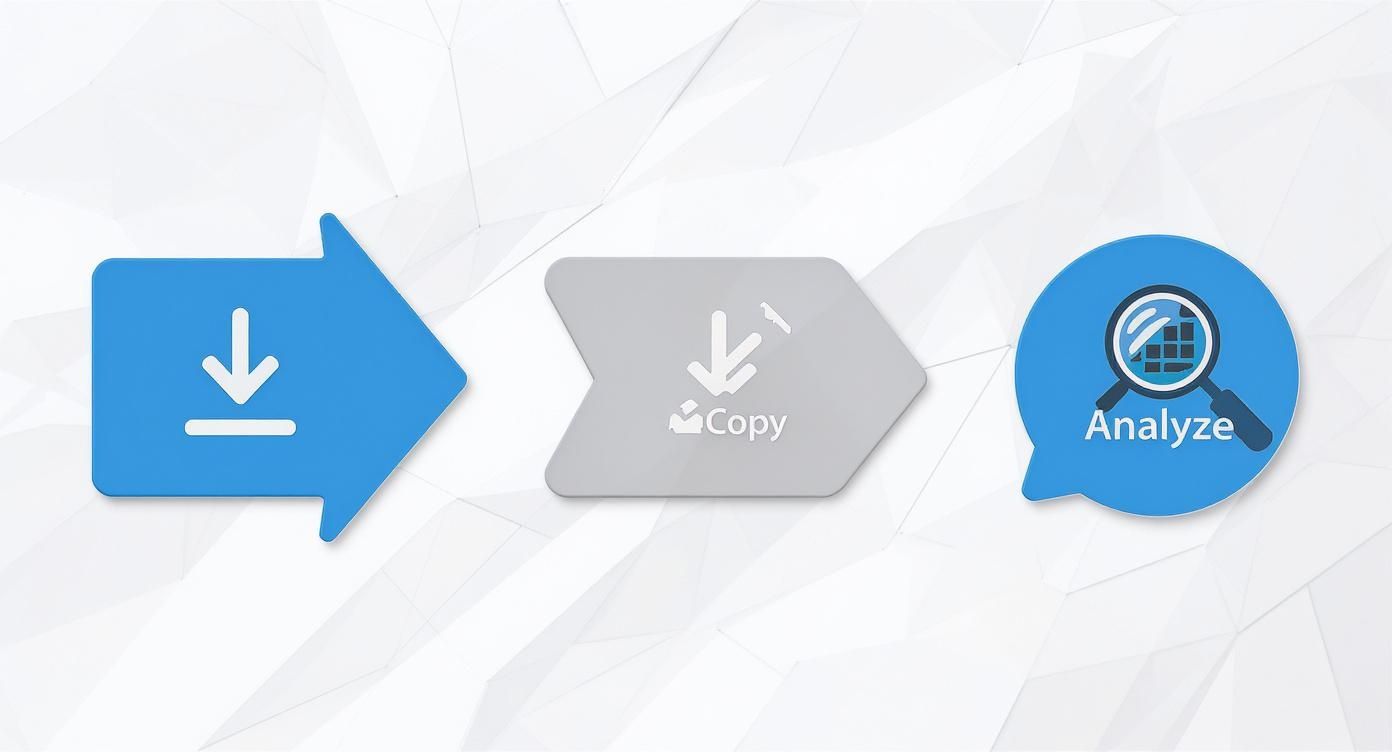
The real magic happens when you move from just having the file to actively using it as a tool to uncover insights.
Breaking Down Their Products And Pricing
With the company overview done, it's time to dig into what they actually sell. You're not just making a list of their products; you're mapping out their entire value proposition and how they make money from it.
For a SaaS business, this means dissecting their pricing tiers. You need to ask:
- What are the core features in their free or cheapest plan?
- Which features do they use as bait to get you to upgrade?
- Is their pricing based on users, usage, or a flat fee?
- Are there any sneaky add-ons or upsells hidden outside the main plans?
If you're in e-commerce, your focus will shift a bit. You'll analyze their product catalog, the quality of their materials, and any unique selling points they're shouting about. But don't stop at the price tag. Look at their shipping and return policies, too—these are huge parts of the customer experience.
Uncovering Their Marketing Playbook
This is where you'll find the juiciest details. A company's marketing tells you exactly who they're trying to reach and how they're getting in front of them.
Start with their website and content. A tool like Similarweb can give you a ballpark estimate of their monthly traffic and where it comes from. This is crucial. Are they grinding it out with organic search, or are they just buying their way in with paid ads?
Next, you'll want to get into their SEO strategy. Using a tool like Ahrefs or SEMrush, you can find the keywords they rank for. Zero in on the keywords with high commercial intent—these are the money-makers. Jot down their top 5 to 10 performing keywords in your template. This information is pure gold.
Don't forget to look at who is linking to them. Quality backlinks from respected sites in your industry are a huge signal of a strong content and PR game. Understanding this process is a key piece of the puzzle. For a deeper dive, check out our guide on what competitive intelligence analysis really involves.
Data-driven decisions are becoming the norm, and these templates are a big part of that. Research shows that companies using a multi-faceted approach see a 25% improvement in spotting market gaps. Another study of over 500 companies found that 60% said templates helped them sharpen their product roadmaps and market timing.
Gauging Their Social Media And Community Vibe
Social media offers a direct window into a brand's personality and what its customers really think. Your job is to look past the vanity metrics.
Forget follower counts for a second and look at engagement. Are people actually commenting, sharing, and reacting to their posts? A competitor with 10,000 engaged followers is way more of a threat than one with 100,000 who are completely silent.
Pay attention to what they post on each platform. Is their LinkedIn all business and case studies while their Instagram is full of team photos and memes? This shows you how they tailor their message for different audiences.
A little pro tip I've picked up: search for your competitor's name on Reddit or in niche industry forums. This is where you find the raw, unfiltered customer feedback—the good, the bad, and the ugly. It adds a layer of real-world context that you just can't get from numbers alone.
Finding High-Quality Company Data
Getting accurate, deep-dive information can be tough, especially for private companies. Public sources are a great starting point, but they often don't tell the whole story about a competitor's true size, funding, or corporate structure.
This is where data enrichment comes in handy. These tools can take a single piece of info, like a company domain, and layer on a ton of valuable data points like employee count, estimated annual revenue, and even the tech they use.
To really get the full picture, consulting a B2B data enrichment guide can help you source top-notch information for your template. It's a smart way to fill in the tougher sections of your analysis and build a much richer understanding of your competitor's resources and scale.
Using The Right Tools For The Job
Let's be real: trying to gather all this information by hand would take forever. Thankfully, there are plenty of tools out there to speed things up. Building a small toolkit is the key to filling out your free competitive analysis template efficiently.
To make it easier, I've put together a list of tools I personally recommend for finding specific pieces of information.
Recommended Tools for Data Collection
| Data Point | Free Tool Suggestion | Paid Tool Suggestion |
|---|---|---|
| Website Traffic & Sources | Similarweb (Free Version) | SEMrush or Ahrefs |
| SEO Keywords & Backlinks | Ubersuggest | Ahrefs or Moz Pro |
| Social Media Engagement | Manual review on platforms | Sprout Social or Hootsuite |
| Paid Ad Copy & Strategy | Google Search | SpyFu or iSpionage |
| Company Funding & Size | Crunchbase (Free Version) | PitchBook or Dealroom |
| Technology Stack | BuiltWith Browser Extension | Wappalyzer API |
You don't need to subscribe to everything at once. Start with the free versions to get a baseline. As you get more serious, investing in a paid tool like SEMrush or Ahrefs can save you dozens of hours and give you far more accurate data. The goal is to pick the tools that fill your biggest knowledge gaps. Combine them with the template's structure, and you'll build a powerful, data-backed view of your competitive landscape in no time.
Turning Your Competitive Data Into Actionable Insights
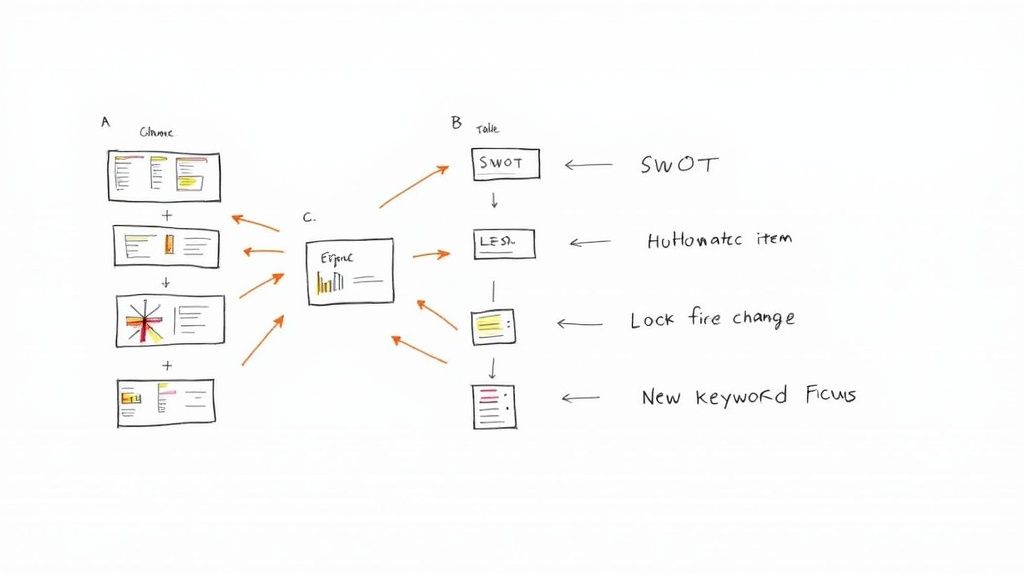
A filled-out free competitive analysis template is a great first step, but let's be honest—on its own, it’s just a spreadsheet full of facts. The real magic happens when you transform that raw data into a concrete plan that gives you an actual edge.
The goal isn't just to know what your competitors are up to. It's about knowing what you should do next because of it.
This process is less about complex data science and more about good old-fashioned pattern recognition. You’re looking for the story the data is telling. A single data point might be interesting, but when you see a cluster of related points, that’s when you’ve found a real insight.
For instance, you might notice your top three competitors all seem laser-focused on high-end enterprise clients. At the same time, your social media listening shows a growing chorus of mid-market companies asking questions that are being completely ignored. That’s not two random facts; it’s a bright, flashing sign pointing to an underserved market you could potentially own.
From Raw Data to a SWOT Analysis
The classic SWOT analysis is still one of the best frameworks for making sense of all this research. It’s a simple but powerful tool that acts as a bridge, getting you from data collection to genuine strategic planning.
SWOT, of course, stands for Strengths, Weaknesses, Opportunities, and Threats. Here’s how to plug the data from your template right into it:
- Strengths (Internal): Where do you have a clear advantage? Maybe your analysis revealed a more engaged social community or a more flexible pricing model. List these as wins you can double down on.
- Weaknesses (Internal): Time for some brutal honesty. Where are you falling short? Perhaps competitors consistently outrank you for crucial SEO terms or offer a key feature you’re missing. These are the internal gaps that need your attention.
- Opportunities (External): These are the favorable winds in the market you can catch. That underserved mid-market segment we just talked about? That goes here. So does a new social platform your rivals are snoozing on.
- Threats (External): What's on the horizon that could hurt your business? A new, well-funded competitor crashing the party or a rival launching an aggressive pricing strategy are perfect examples.
The most common mistake I see is confusing internal factors with external ones. Your pricing model is a weakness (internal). A competitor slashing their prices is a threat (external). Keeping that distinction sharp is crucial for a SWOT analysis that actually works.
Using this framework forces you to look at your data from all four angles. It prevents you from getting fixated on just the good or the bad and helps you build a balanced picture of the entire competitive landscape.
Prioritizing Your Next Moves
Once your SWOT is complete, you’ll probably be staring at a long list of potential actions. Now what? The final, crucial step is to prioritize. Not every opportunity is worth chasing, and not every weakness needs to be fixed right this second.
I’m a big fan of a simple prioritization matrix. Just draw two axes: Impact (how much will this move the needle?) and Effort (how much time, money, and manpower will it take?).
This gives you four easy-to-understand quadrants:
- High Impact, Low Effort (Quick Wins): These are your top priorities. Go after them now. An example could be targeting a long-tail keyword your competitors have ignored, which might only require a couple of new blog posts.
- High Impact, High Effort (Major Projects): These are the big, strategic initiatives. Think: developing a flagship feature that addresses a major market gap. They need careful planning but promise huge returns.
- Low Impact, Low Effort (Fill-in Tasks): These are the "nice-to-haves" that won't change the game overnight. Slot them in when you have some spare capacity.
- Low Impact, High Effort (Avoid): These are the time and money sinks. A complete website redesign might sound tempting, but if your current site converts well and competitors aren't winning on design, the effort will almost certainly outweigh the impact.
By plotting your ideas onto this matrix, you move from a chaotic brainstorm to a clear, ordered to-do list. And just like that, your free competitive analysis template has evolved from a simple research document into a strategic roadmap for growth.
Keeping Your Competitive Analysis Current and Relevant
https://www.youtube.com/embed/0KyCAcV_y7o
Finishing your free competitive analysis template feels great, but it’s really just a snapshot in time. The market, on the other hand, is a live video feed. Competitors are constantly launching features, tweaking pricing, and spinning up new marketing campaigns. If you let it sit, that brilliant spreadsheet will quickly become a historical document.
The real power comes from treating your analysis as a living, breathing resource. This doesn't mean you need to be glued to your screen, manually updating it every day. It's about building a smart, sustainable rhythm for tracking the landscape so you’re always working with fresh intel.
Establishing a Sustainable Monitoring Schedule
One of the biggest mistakes I see is a "feast or famine" approach—either total neglect or a frantic, last-minute scramble for information. You need a system. The best way to do this is to break down your monitoring into manageable chunks based on how quickly things change.
Here’s a practical framework that works well:
- Weekly Checks: Keep these quick and focused on fast-moving, public activities. Spend 15-20 minutes scanning your top three competitors' social media, new blog posts, or major ad campaigns. It’s a low-effort way to keep a finger on the pulse of their marketing.
- Monthly Reviews: Go a little deeper here. Look for changes to their website’s homepage or main navigation—these are often tell-tale signs of a strategic pivot. This is also a great time to browse new customer reviews to see what people are saying.
- Quarterly Audits: This is your deep dive. It's time to fully refresh the core sections of your template: pricing, product features, and SEO performance. A quarterly rhythm is the sweet spot; it's frequent enough to catch important shifts without turning into a full-time job.
A structured approach like this turns competitive monitoring from a chore you dread into a manageable and valuable habit.
Automating Intelligence to Keep Your Template Fresh
Trying to manually track every move your competitors make is a surefire path to burnout. It's just not realistic. This is where competitor intelligence tools completely change the game. A platform like ChampSignal can automate the most tedious work, essentially acting as your 24/7 market scout.
These tools can watch competitor websites and ping you the moment a price changes, a new feature is added, or a headline gets rewritten. Your template stays current with very little hands-on effort.
The real magic happens when you connect the dots between small, automated alerts over time. A price drop one week followed by a new feature announcement the next tells a much richer story about your competitor's strategy than either event would on its own.
Businesses that embrace continuous monitoring are seeing real results. Brands that actively use these frameworks report up to a 20% higher ROI on their digital campaigns. And by integrating ongoing monitoring, you can shorten the analysis cycle from months down to weeks, making you far more agile. You can discover more insights about collaborative competitor analysis on miro.com.
Ultimately, a dynamic process means you're never caught flat-footed. When you combine a smart monitoring schedule with the right automation, your free competitive analysis template transforms from a static report into a powerful strategic asset that fuels your growth.
Common Questions I Get About Competitive Analysis
Even with the best template in hand, you're going to have questions once you start digging into competitor research. That's completely normal. I've been doing this for years, and I still have to pause and think things through.
To help you out, I’ve put together answers to the questions I hear most often. Getting these fundamentals right from the start will save you a ton of headaches later and ensure you get real value out of this whole process.
How Many Competitors Should I Actually Analyze?
It’s so tempting to go wide and list every single company that even remotely smells like a rival. Trust me, I've seen it happen. But this is a classic rookie mistake that leads to "analysis paralysis"—you end up with a mountain of data but zero actual insights.
My advice? Start with 3 to 5 key competitors. That’s it. It’s a manageable number that gives you enough information to spot real trends without getting completely swamped.
To make this focused approach work, aim for a healthy mix:
- 2-3 Direct Competitors: These are the obvious ones. They sell a nearly identical product to the same people you do. You probably know them by name already.
- 1-2 Indirect Competitors: These are the companies solving the same core problem for your customers, just in a different way. For example, if you sell project management software, an indirect competitor might be a specialized to-do list app or even a digital whiteboard tool.
You can always expand your list later on. Starting small keeps you focused and helps you score a few quick wins, which is fantastic for building momentum.
How Often Should I Update My Analysis?
Your competitive analysis should be a living, breathing document. It's not a one-and-done report that you create and then file away to gather digital dust. Markets change, and your template needs to keep up.
Now, how often you update it really depends on your industry.
In fast-moving spaces like SaaS, e-commerce, or mobile apps, a quarterly refresh is a good rule of thumb. For more stable industries—think professional services or manufacturing—a deep dive every six months is probably fine.
But don't let a rigid schedule blind you to major events. If a competitor rolls out a massive new marketing campaign, completely revamps their pricing, or lands a huge round of funding, you need to log that in your template right away. Those big, game-changing moves are often the most valuable nuggets of intel you can find.
What's the Biggest Mistake to Avoid?
This one is easy because I see it all the time. The single biggest mistake is getting stuck collecting data and never actually doing anything with it.
The whole point of this free competitive analysis template isn't to create a perfectly filled-out spreadsheet. The real magic is in the "so what?"—the actions you take based on what you've learned. You have to carve out dedicated time to look at the data, interpret what it means, and build a concrete action plan.
An incomplete template that leads to three powerful, data-backed decisions is infinitely more valuable than a perfectly detailed one that just sits in a folder. Don't let perfection become the enemy of progress.
Will This Template Work for My Industry?
Absolutely. I designed this template from the ground up to be flexible. The core categories—Product, Pricing, Marketing, Company Profile—are fundamental building blocks for pretty much any business out there.
The real power of the template is how you can customize it. Think of it as a starting point, not a straitjacket.
- An e-commerce brand might add columns for "Shipping Policies," "Return Process," or "Average Product Review Score."
- A local service business could add fields for "Google Business Profile Ratings," "Service Area Covered," or "Online Booking Options."
- A B2B software company would probably want to track "G2/Capterra Ratings," "Integration Partners," or "Case Study Availability."
The key is to tailor it to track what actually matters in your market. Add, remove, or rename columns to make this template a perfect fit for your own strategic needs.
Ready to stop guessing what your competitors are doing? ChampSignal automates the tedious work of competitor monitoring by tracking website changes, pricing updates, and new marketing campaigns for you. Get high-signal alerts delivered straight to your inbox so you can focus on strategy, not spreadsheets. Start your free trial at champsignal.com.
Stay Ahead
Don't just find competitors. Stay ahead of them.
Auto-discover new competitors in your market. Get alerts when they change pricing, features, emails, ads, or messaging.
Stay ahead without the tracking busywork.
See competitor pages, emails, social posts, ads, and SEO signals in one place.
What ChampSignal watches for you
The channels competitors own, the places people talk about them, and the alerts that matter when something changes.
Website & Email Monitoring
Page updates, pricing changes, messaging shifts, and competitor newsletters.
Social Monitoring
X posts, Reddit threads, and other public social chatter.
Ads Monitoring
Ad copy, creatives, and landing pages across Google and Meta.
SEO Monitoring
Keywords, backlinks, and ranking shifts tied to competitor pages.
Auto Competitor Discovery
New rivals surfaced before they show up in deals or search.
High-Signal Alerts
The few alerts and digests that matter, delivered by email or Slack.