


Top 6 competitor keyword analysis tools for founders

Maxime Dupré
11/26/2025

Your competitors are already telling you exactly which keywords convert customers and drive traffic. The challenge isn't a lack of data; it's accessing and interpreting it. Without the right tools, you're essentially guessing which search terms matter while your rivals are systematically capturing market share based on proven strategies. This is a critical blind spot for many founders and go-to-market teams, leading to wasted ad spend and missed organic growth opportunities.
This guide eliminates that guesswork. We've compiled a comprehensive list of the best competitor keyword analysis tools designed to uncover the exact search queries your competitors rank for and bid on. Each review dives deep into key features, pricing, and ideal use cases, helping you pinpoint the platform that best fits your budget and workflow. We'll show you how to find keyword gaps, analyze paid search campaigns, and integrate this intelligence directly into your own strategy.
For those focused specifically on paid campaigns, exploring the best PPC keyword research tools can provide additional, specialized insights. In this list, you will find a detailed breakdown of 12 powerful platforms, complete with screenshots and direct links, to help you make a confident decision and start turning competitor insights into your own strategic advantage.
1. ChampSignal
Best For: All-in-one, AI-powered competitor monitoring with high-signal alerts.
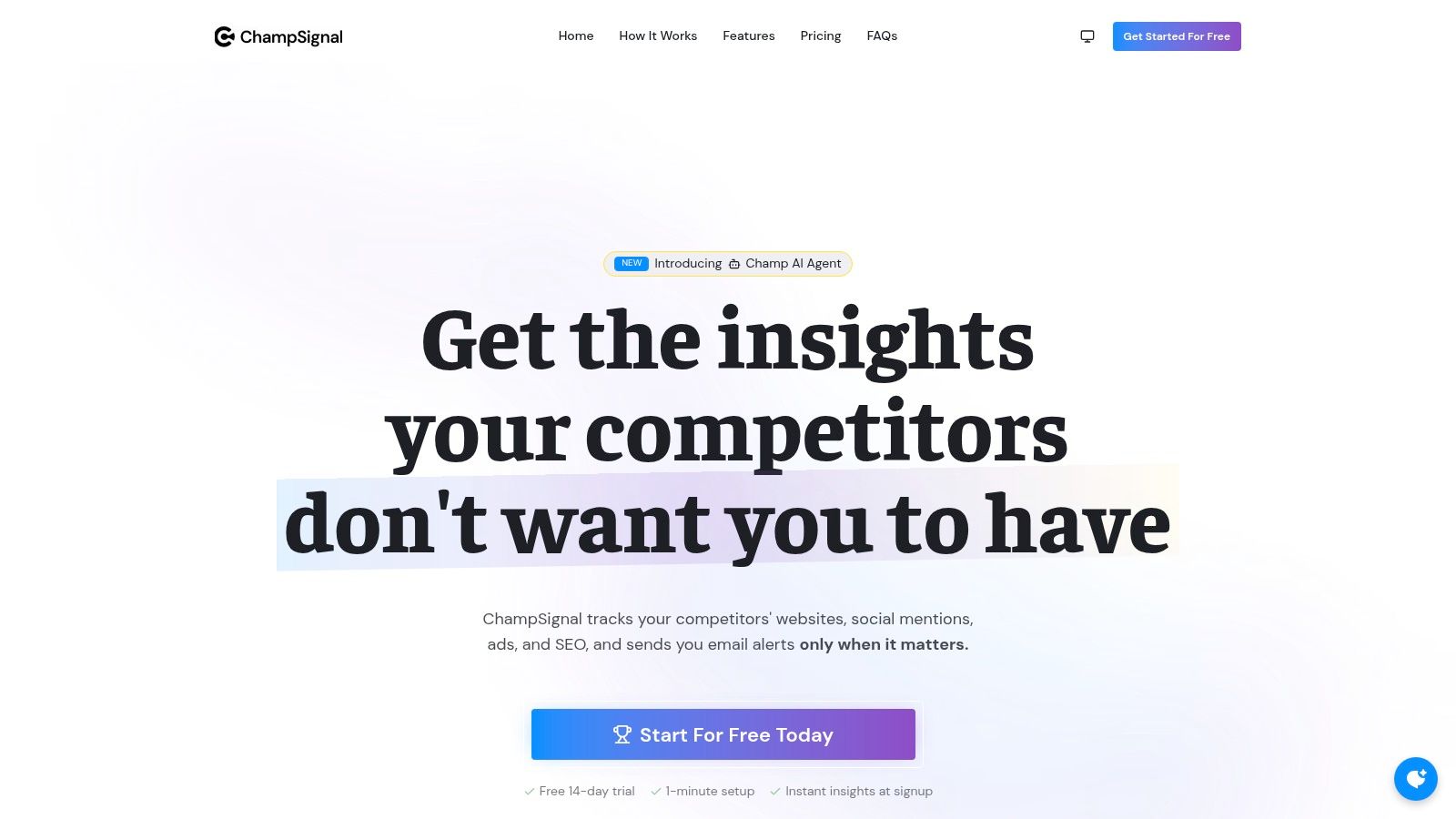
ChampSignal stands out by integrating keyword analysis into a comprehensive competitor monitoring ecosystem. While many tools focus solely on keyword data, ChampSignal positions itself as a strategic intelligence platform. It automates the tracking of competitor keyword rankings, Google Ads, website changes, and even Reddit conversations, using AI to filter out noise and deliver only high-signal alerts. This makes it an exceptional choice for founders and GTM teams who need actionable insights, not just raw data.
The platform’s strength lies in its ability to connect the dots. You don't just see a competitor's new keyword ranking; you see it alongside the new landing page they launched to support it and the Google Ads they're running to promote it. This holistic view provides critical context that standalone competitor keyword analysis tools often miss.
Key Features & Use Cases
- AI-Filtered Alerts: ChampSignal’s core differentiator is its use of AI and statistical outlier detection. It automatically monitors multiple channels and surfaces only significant changes, sending alerts via Slack or email. This saves countless hours of manual checking and reduces alert fatigue.
- Integrated Keyword & Ad Tracking: Track your rivals' organic keyword positions and see their exact Google Ads creatives. This dual capability allows you to reverse-engineer their most successful SEO and PPC strategies simultaneously.
- Champ AI Agent: This is a powerful analysis tool. You can ask the AI to summarize a competitor's recent strategy shifts, spot emerging keyword trends across the market, or even generate a sales battlecard based on their latest messaging and feature updates.
- Contextual Evidence: Every alert includes proof, such as screenshots, HTML diffs, and historical data. This allows your team to validate the change and react with confidence, all without leaving the alert notification.
Pricing & Setup
ChampSignal offers a straightforward pricing model with a 14-day free trial and a 30-day money-back guarantee, making it low-risk to evaluate.
- Focused Plan: Aimed at small teams, tracking ~5 competitors.
- Competitive Plan: Designed for busier markets, covering ~15 competitors.
- Custom Plans: Available for enterprises needing broader coverage.
Setup is remarkably fast, taking just one minute to start monitoring. The interface is clean, and the platform offers worldwide keyword coverage and human support.
| Pros | Cons |
|---|---|
| Holistic Monitoring: Combines keywords, ads, website changes, and social mentions for a complete picture. | Tracker Limits: Standard plans have a set number of competitor slots; large enterprises will need custom pricing. |
| High-Signal Alerts: AI-powered filtering drastically reduces noise and saves significant time. | Potential for Missed Signals: Aggressive filtering may occasionally miss very subtle changes; settings can be tuned. |
| Actionable AI Insights: The Champ AI Agent provides summaries, battlecards, and strategic suggestions. | |
| Fast Setup & Integration: Get started in one minute with seamless Slack and email notifications. |
Website: https://champsignal.com
2. Semrush
Semrush is an all-in-one digital marketing suite, but its strength as one of the top competitor keyword analysis tools lies in its vast datasets for both SEO and PPC. It’s an ideal choice for teams wanting a single platform to manage broad competitive intelligence, from organic rankings to paid ad copy.
The platform excels at providing deep insights into a competitor's strategy. You can input any domain into the Organic Research tool to instantly see every keyword they rank for, their traffic estimates, and SERP positions. For a more direct comparison, the Keyword Gap tool lets you compare your domain against up to four competitors, highlighting keywords you share and, more importantly, keywords they rank for that you're missing. This feature is a goldmine for discovering new content opportunities.
Key Features & Use Case
- Organic & Paid Research: Uncover competitors' top keywords, ad copy, and landing pages.
- Keyword Gap Tool: Identify keyword opportunities by comparing your domain to rivals.
- Position Tracking: Monitor your keyword performance against competitors with daily updates.
Pricing & Limitations
Pricing starts with the Pro plan at $129.95/month, scaling up for more features and higher limits. The main limitation, especially for smaller businesses, is that the cost can escalate with add-ons like market intelligence (Semrush .Trends). The "project" limits on lower tiers can also feel restrictive if you manage multiple web properties.
Practical Tip: Use the Keyword Gap tool's "Weak" and "Untapped" filters to quickly prioritize keywords where your competitors are ranking but you have a poor position or no presence at all. This is a fast track to building out your content calendar. To put these insights into action, you can follow a structured process detailed in our guide on how to perform an SEO competitor analysis.
3. Ahrefs
Ahrefs is a powerhouse SEO platform renowned for its colossal backlink index and deep keyword research capabilities. For teams focused on reverse-engineering a competitor's organic success, Ahrefs offers one of the clearest paths, making it a staple among competitor keyword analysis tools for its data accuracy and actionable workflows.
The platform's strength lies in its Site Explorer tool, which provides a comprehensive overview of any domain’s organic keywords, backlink profile, and top-performing content. To find specific opportunities, the Content Gap feature (similar to Semrush's Keyword Gap) allows you to enter your domain and several competitors to instantly surface keywords they rank for that you don't. This is incredibly effective for identifying high-value topics your audience is searching for.
Key Features & Use Case
- Site Explorer: Analyze any competitor's organic keywords, backlinks, and traffic.
- Content Gap Tool: Find keywords your competitors rank for, but you don't.
- Keywords Explorer: Deep dive into keyword data, including SERP history and difficulty.
Pricing & Limitations
Pricing starts with the Lite plan at $99/month, with costs increasing for more comprehensive features and higher data limits. Ahrefs recently moved to a usage-based credit system, which can be confusing and lead to unexpected costs if you run many reports. The system can feel less predictable than the fixed project limits of some rivals.
Practical Tip: Use the Top Pages report within Site Explorer on a competitor's domain. Filter this list by traffic value to see which of their pages attract the most valuable organic traffic. This helps you prioritize which of their keyword strategies to replicate first for maximum business impact. More details on leveraging this data can be found in our comprehensive guide on how to perform an SEO competitor analysis.
4. Similarweb
Similarweb is a market intelligence platform that excels at providing a high-level, strategic view of the digital landscape. While many competitor keyword analysis tools focus purely on SERP data, Similarweb’s strength is in revealing a competitor's entire traffic mix, allowing you to benchmark your organic performance against their paid search, social, referral, and direct traffic channels.
The platform is ideal for sizing up a competitor's overall market share and understanding where they win demand at a macro level. You can analyze any domain to see its top organic and paid keywords, but also its primary traffic sources and audience geography. This is particularly useful for GTM teams looking to understand not just what keywords to target, but which channels are most effective in a specific industry or market. Its Traffic & Engagement metrics provide a broader context that pure SEO tools often miss.
Key Features & Use Case
- Traffic Sources Analysis: See the full breakdown of a competitor's traffic (Direct, Search, Social, etc.).
- Keyword & Traffic Share: Benchmark your keyword footprint and market share against key rivals.
- Country-Level Filtering: Analyze competitor performance in specific geographic markets.
Pricing & Limitations
Similarweb’s pricing is geared more towards enterprise and larger teams, with plans starting higher than typical SMB-focused SEO tools. While powerful, some of the most advanced features, like its AI agents for market analysis, are locked behind top-tier plans, which may be out of reach for smaller businesses. Access requires contacting their sales team for custom quotes.
Practical Tip: Use Similarweb's Top Keywords report for a competitor, then filter by "Traffic Share" to identify the terms that drive the most significant volume for them. This helps you prioritize high-impact keywords that are proven to attract a large audience, moving beyond simple search volume metrics. Learn more at https://www.similarweb.com.
5. SpyFu
SpyFu is a highly specialized competitor intelligence tool that focuses almost exclusively on SEO and PPC research. It’s built from the ground up to deconstruct your rivals’ digital marketing playbooks, making it an excellent choice for teams needing deep, actionable data on competitor keywords and ad strategies without the overhead of a full marketing suite. Its generous data limits on paid plans offer significant value.
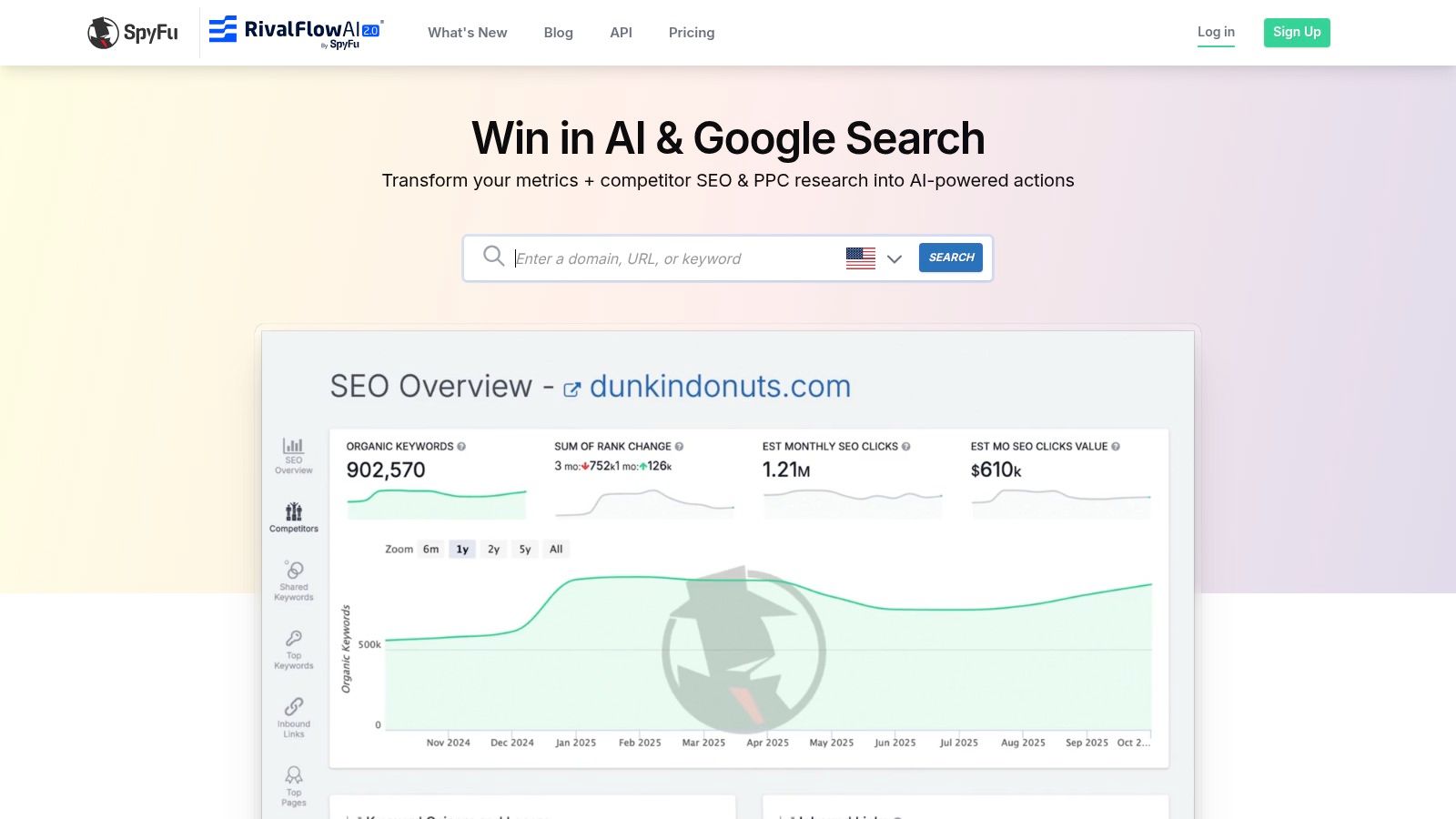
The platform shines with its historical data, allowing you to see how a competitor's keyword strategy has evolved over years. The Kombat feature is SpyFu’s version of a keyword gap analysis, visualizing the keyword universe between you and two competitors. It clearly identifies the keywords your competitors rank for that you don't, which is ideal for pinpointing immediate content and PPC opportunities to close the gap.
Key Features & Use Case
- PPC & SEO Competitor Research: Uncover every keyword a competitor has bought on Google Ads and every keyword they rank for organically.
- Kombat Keyword Tool: A visual domain comparison tool to find keyword overlaps and gaps.
- Historical Data: Track a competitor’s ranking and ad history for over a decade.
Pricing & Limitations
SpyFu's pricing is very accessible, starting with a Basic plan around $39/month. A key advantage is that even the lowest-tier plans offer unlimited search results and data exports. The primary limitation is that its interface and some of its data metrics can feel different from all-in-one suites, which might require an adjustment period. Its keyword volume estimates can also differ from other industry tools.
Practical Tip: Use SpyFu's "Top Lists" feature to identify the biggest spenders or most dominant domains in a specific niche. You can then analyze these market leaders to reverse-engineer their most profitable keywords and ad copy, providing a proven blueprint for your own campaigns. Learn more at spyfu.com.
6. Moz Pro
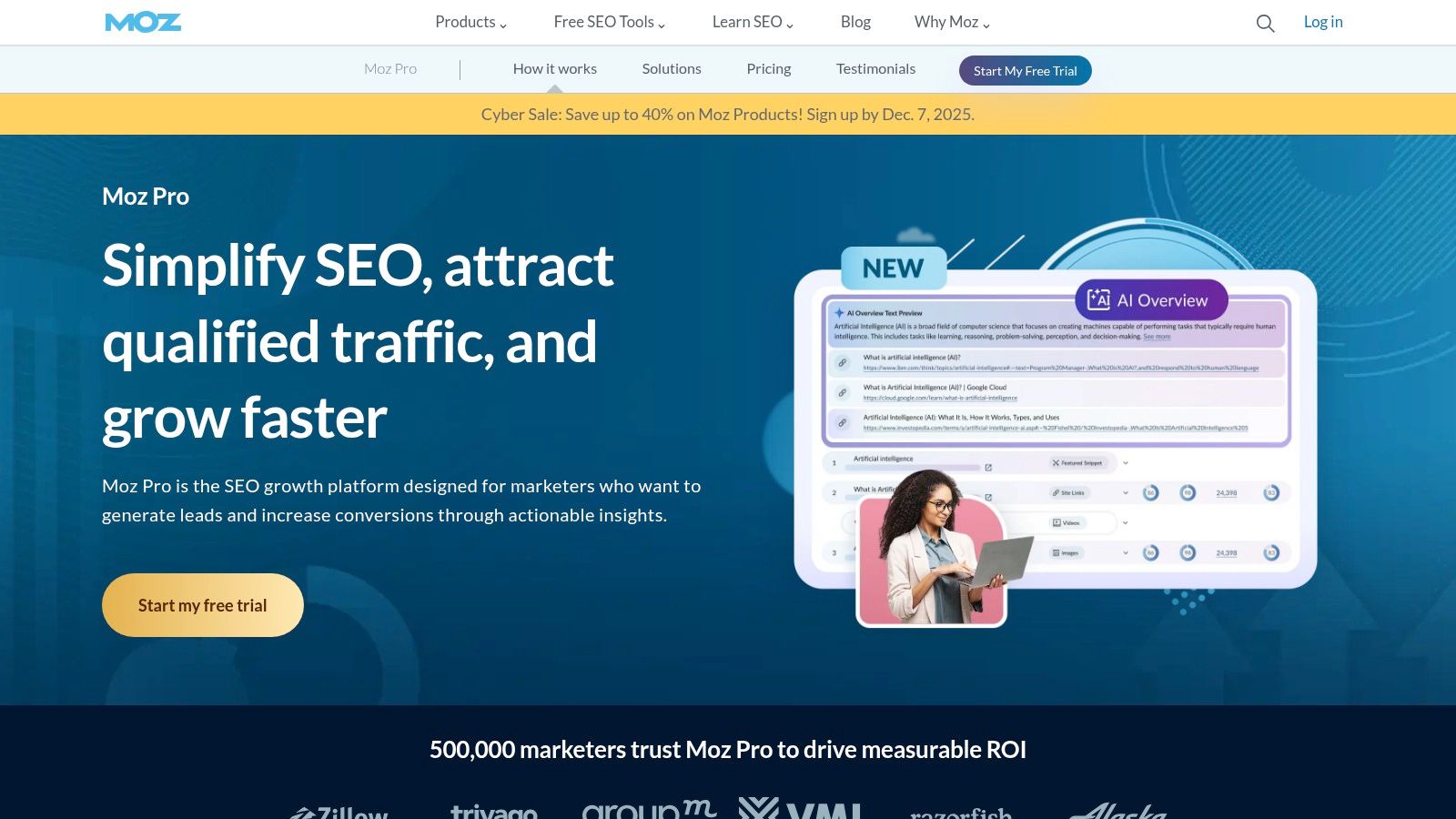
Moz Pro is one of the original SEO software suites, offering a balanced and approachable platform for founders and marketing teams. It stands out as one of the best competitor keyword analysis tools for those who value a clean user interface and educational resources alongside powerful data. Its proprietary metrics like Domain Authority (DA) provide a quick benchmark for competitive strength.
The platform's Keyword Explorer is the core of its competitive analysis toolkit. You can enter a competitor's domain to see all the keywords they rank for, along with estimated click-through rates and SERP features. Its "Ranking Keywords" report provides a straightforward list of your rival's top-performing terms, which you can easily export or add to a tracking campaign. While its keyword database may not be as vast as some competitors, its focus on accuracy and usability makes it highly effective.
Key Features & Use Case
- Keyword Explorer: Analyze any domain to uncover its ranking keywords and SERP visibility.
- Competitive Research: Compare link profiles and benchmark against competitors using metrics like Domain Authority.
- Campaigns: Track your keyword rankings against key rivals in specific geographic markets.
Pricing & Limitations
Moz Pro's pricing begins with the Standard plan at $99/month, with tiers scaling up for more campaigns and keyword reporting limits. A significant limitation is that its keyword database, while high-quality, can sometimes be smaller than those of top-tier competitors like Semrush or Ahrefs. This might result in missing some long-tail opportunities that larger crawlers would pick up.
Practical Tip: When analyzing a competitor in Keyword Explorer, switch the view to "Group by Parent Topic." This clusters thousands of long-tail variations under a primary keyword, helping you see the strategic content pillars your competitor is targeting rather than getting lost in individual keywords. This is an efficient way to structure your own content strategy. To learn more about their offerings, visit the official Moz Pro page.
7. Serpstat
Serpstat is an all-in-one SEO platform that positions itself as a highly accessible tool for competitor keyword analysis, particularly for freelancers and small businesses. Its strength lies in providing a robust set of features, including keyword research, rank tracking, and site auditing, at a more attractive entry price point compared to some industry giants. This makes it a solid choice for teams needing comprehensive functionality without the enterprise-level budget.
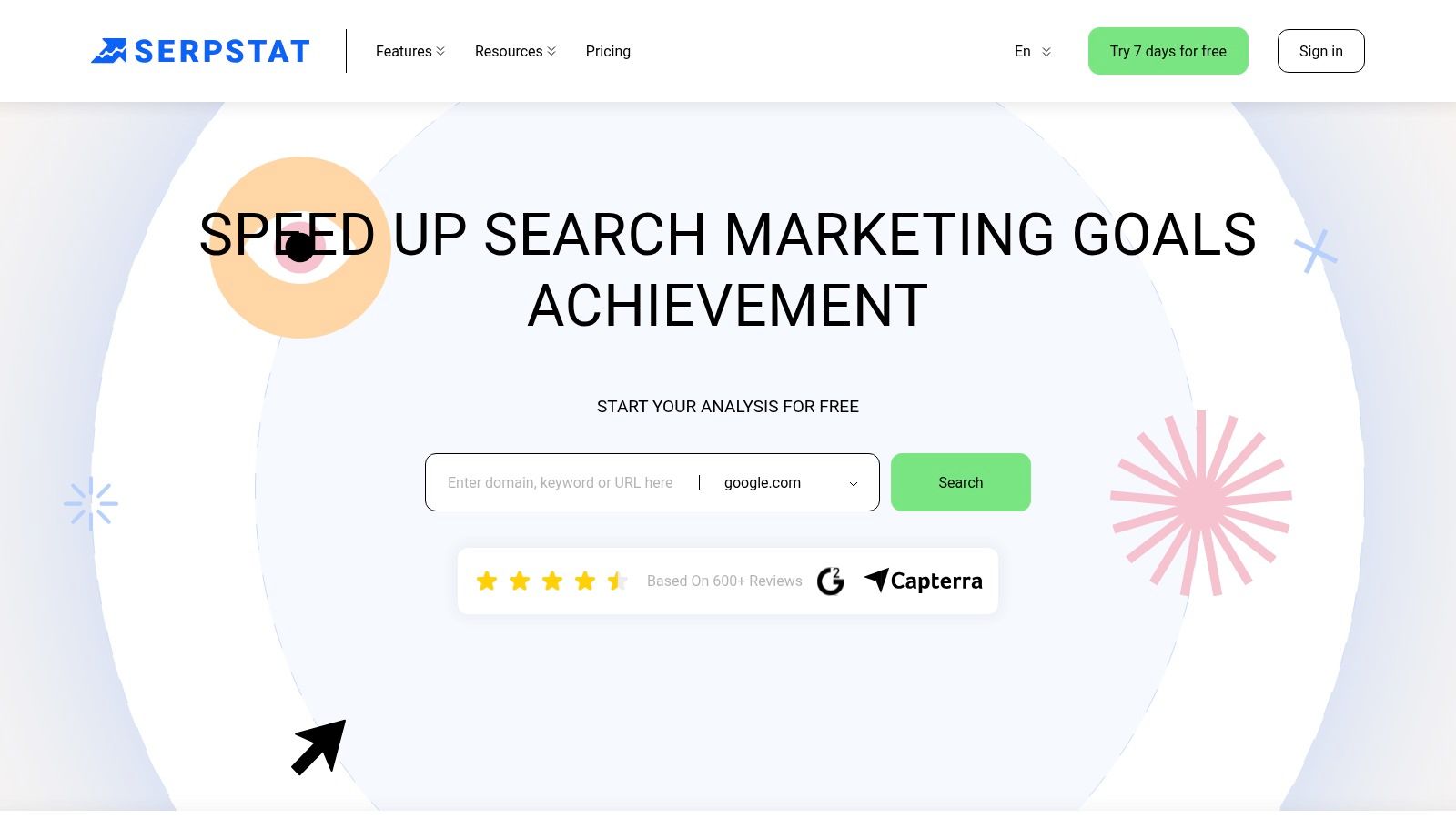
The platform’s Domain Analysis tool provides a quick overview of any competitor’s organic keywords, traffic volume, and top-performing pages. Similar to more expensive tools, Serpstat includes a "Missing Keywords" feature that compares your domain to competitors and reveals valuable keyword gaps. Its batch analysis capabilities are also a time-saver, allowing you to research up to 200 domains at once to quickly gauge the competitive landscape.
Key Features & Use Case
- Domain & Keyword Research: Analyze competitors' keyword strategies and identify content gaps.
- Rank Tracker: Monitor your keyword positions against competitors across the top 100 search results.
- Batch Analysis: Quickly compare keyword or domain metrics for up to 200 competitors simultaneously.
Pricing & Limitations
Pricing begins with the Lite plan at around $50/month (with annual payment), making it one of the more affordable full-featured tools. The main limitation is that its data depth and interface can feel slightly less comprehensive than top-tier suites like Ahrefs or Semrush. While functional, the user experience may not be as polished for advanced users.
Practical Tip: Use the "Compare domains" report within the Domain Analysis section to visualize your keyword overlap with two other competitors. Focus on the keywords unique to your rivals to find immediate, proven content ideas that your audience is already searching for. You can directly export this list to begin your content planning. For more information, visit Serpstat's official website.
8. SE Ranking
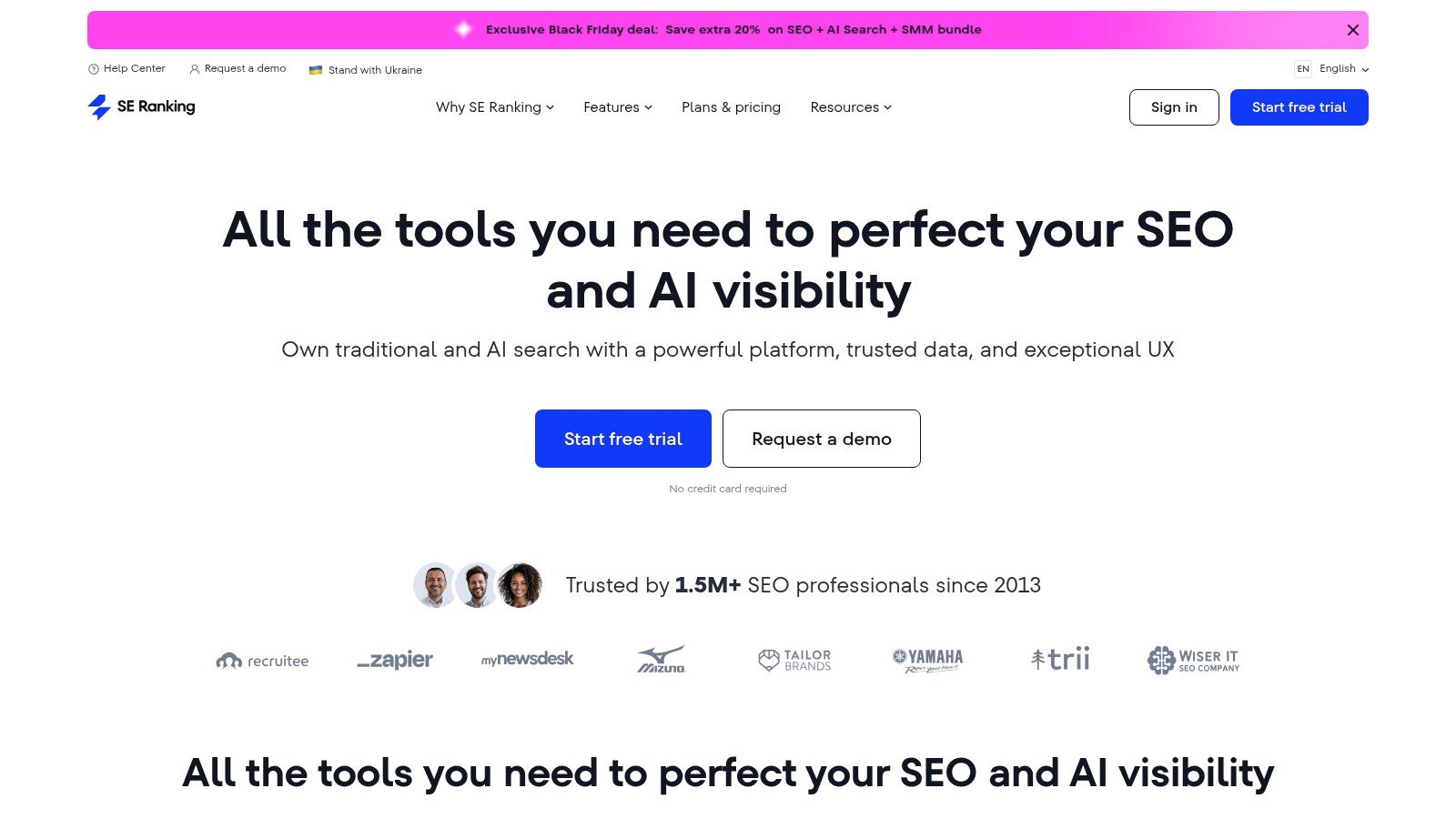
SE Ranking is a comprehensive SEO platform known for its flexible, agency-friendly pricing and robust feature set. It has carved out a strong position as one of the most cost-effective competitor keyword analysis tools, offering deep competitive research, rank tracking, and site auditing without the enterprise-level price tag of larger rivals. It’s an excellent choice for SMBs, agencies, and marketers who need a powerful all-in-one solution with predictable costs.
The platform’s Competitive Research tool is the core of its analysis capabilities. You can enter any competitor’s domain to see their organic and paid keywords, traffic trends, and top-ranking pages. SE Ranking’s keyword gap feature allows you to compare your domain against multiple competitors, clearly showing keywords you’re missing out on. Its growing AI features, like the AI Results Tracker, are also adding a modern layer to traditional SERP analysis.
Key Features & Use Case
- Competitive Research: Analyze any domain’s organic and paid keyword strategies.
- Keyword Gap Analysis: Identify keyword opportunities by comparing your site to competitors side-by-side.
- Rank Tracker: Monitor keyword positions across major search engines with detailed share-of-voice metrics.
Pricing & Limitations
Pricing is highly flexible, starting at $55/month, with costs scaling based on the frequency of rank tracking updates. The Business plan offers unlimited projects, a major plus for agencies. The primary limitation is that its keyword database, while substantial, can be smaller than industry giants like Semrush or Ahrefs, which might affect hyper-niche or international research.
Practical Tip: Use SE Ranking’s Competitive Research tool to identify a competitor's top-performing pages in terms of traffic and keywords. Analyze the structure and content of these pages to create a superior version, targeting the same high-value keywords. This "skyscraper" technique is a proven way to capture their traffic. You can find more information about this tool directly on their website.
9. Mangools (KWFinder)
Mangools positions itself as the user-friendly, design-forward choice in the often-complex world of SEO tools. Its suite, with KWFinder at the core, is one of the best competitor keyword analysis tools for freelancers, bloggers, and small businesses who need powerful data without a steep learning curve or enterprise-level price tag. The entire platform is built around simplicity and visualizing data clearly.
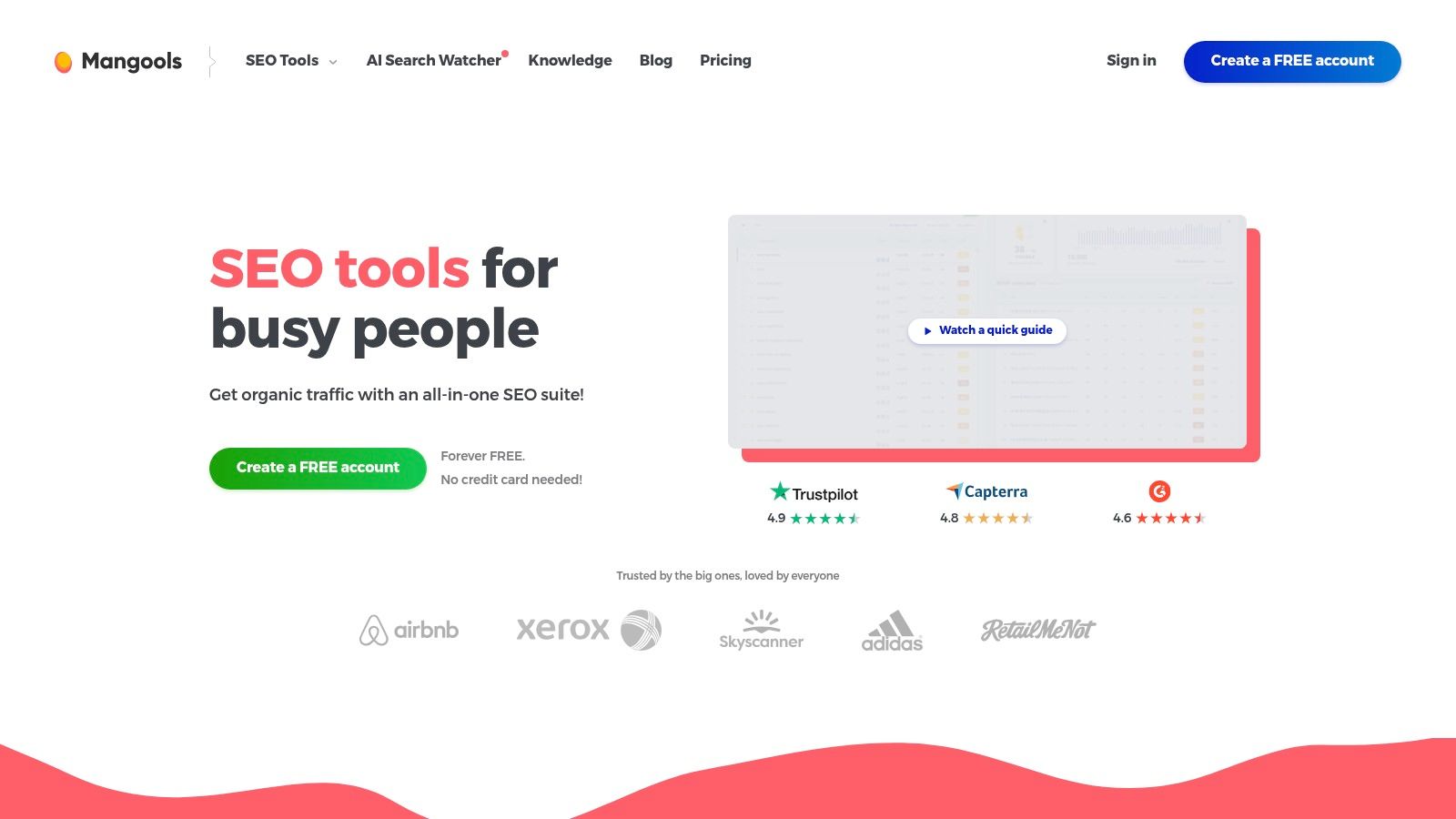
The primary tool for this task, KWFinder, allows you to search by a competitor's domain to see the keywords they rank for. While it's more focused on keyword discovery than deep competitor profiling, this feature provides a quick and clean list of potential targets. It excels at generating new keyword ideas with accurate difficulty scores, making it easy to assess opportunities at a glance. For SERP analysis, the SERPChecker tool complements this by showing you the top-ranking pages for a keyword, complete with key SEO metrics.
Key Features & Use Case
- KWFinder by Domain: Enter a competitor’s URL to pull a list of keywords they rank for.
- SERPChecker: Analyze the SERP for any keyword to evaluate the authority and on-page strength of competitors.
- Beginner-Friendly UI: Clean, color-coded interface simplifies keyword difficulty and search volume data.
Pricing & Limitations
Pricing is very accessible, starting with the Mangools Basic plan at $49/month. This makes it a great value proposition for those on a tighter budget. The primary limitation is that it's a bundled suite, so you can't purchase KWFinder alone. Additionally, the daily lookup and keyword limits are lower than on platforms like Semrush or Ahrefs, making it less suitable for high-volume agency or enterprise use.
Practical Tip: Use KWFinder’s "Search by Domain" feature to find a competitor’s top-performing keywords. Then, plug those keywords directly into SERPChecker to get a detailed breakdown of the top 10 results, including Domain Authority, link profiles, and other key metrics. This two-step process helps you quickly validate if you can realistically compete for that term.
10. iSpionage
iSpionage is a competitive intelligence platform with a strong focus on Pay-Per-Click (PPC) advertising, making it one of the more specialized competitor keyword analysis tools available. It’s an excellent choice for teams that want to dive deep into competitors' paid search strategies, uncovering their most profitable keywords, ad copy, and landing page combinations.
While its primary strength is in PPC, it also offers solid SEO keyword research and rank tracking. You can enter a competitor's domain to see their top organic keywords and estimated traffic value. The platform's real power comes from features like Campaign Watch, which actively monitors and sends alerts when competitors launch new ads or keywords, giving you a real-time pulse on their paid acquisition tactics.
Key Features & Use Case
- Competitor PPC & SEO Keywords: Uncover paid and organic keywords, ad copy, and landing pages.
- Campaign Watch & Alerts: Get notifications on competitors' new paid search activities.
- Local SEM Monitoring: Track keyword performance and ad campaigns at a local level.
Pricing & Limitations
Pricing starts with the Starter plan at $59/month, with a 30-day money-back guarantee. Higher tiers add more projects, alerts, and white-label reporting. The main limitation is its narrower feature set compared to all-in-one suites like Ahrefs or Semrush. It is hyper-focused on PPC and SEO keyword intelligence and lacks the broader toolset for things like technical SEO audits or link building.
Practical Tip: Use the "PPC Campaign Watch" feature to monitor your top three to five direct competitors. Set up alerts to be notified of their new ad copy and keyword tests. This provides a direct feed of inspiration for your own A/B testing efforts and helps you react quickly to shifts in their paid strategy. For more on this, check out the official iSpionage website.
11. Ubersuggest
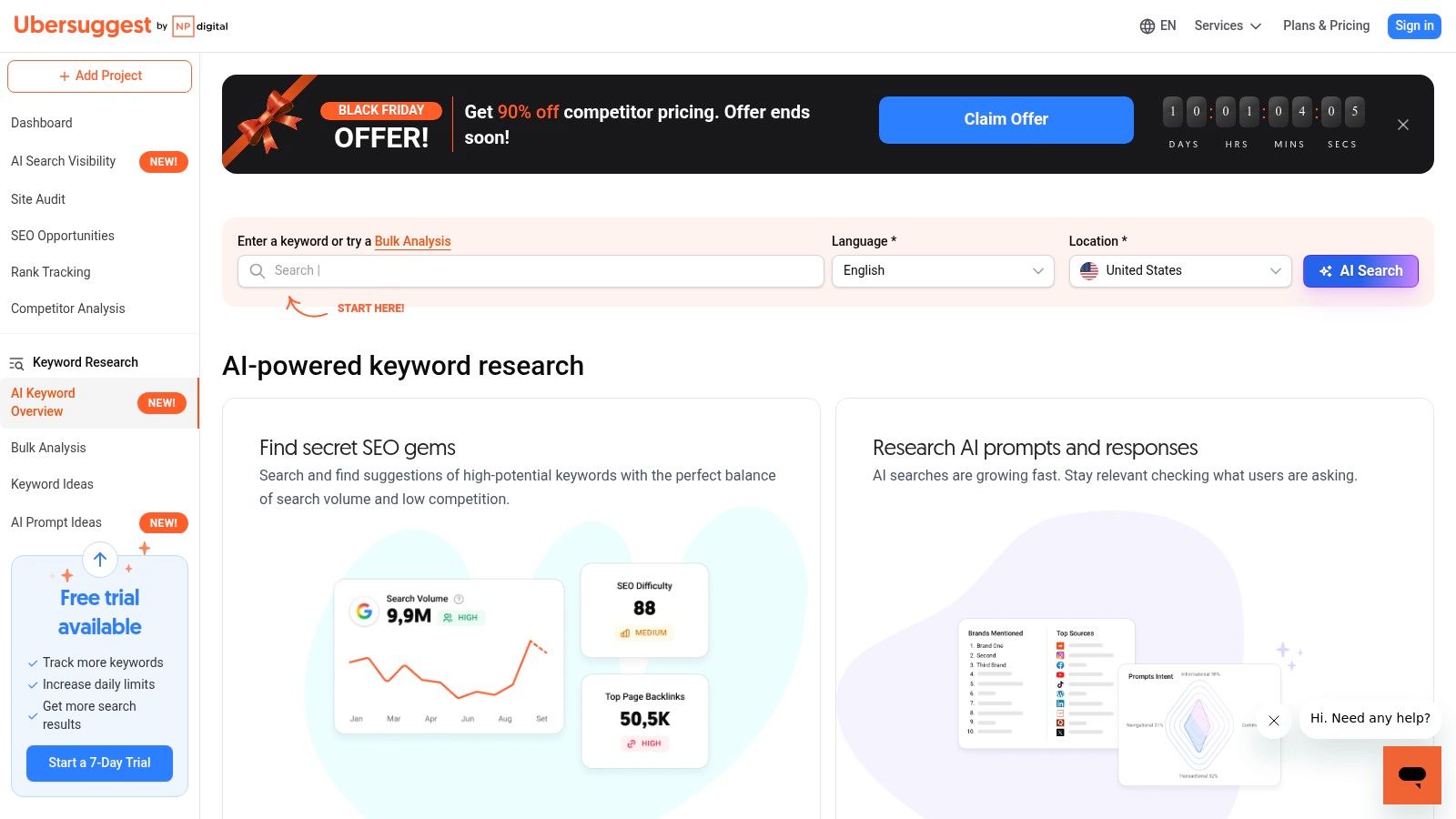
Ubersuggest, developed by Neil Patel, positions itself as an accessible and budget-friendly SEO platform, making it a popular choice for freelancers, SMBs, and marketers just starting with competitor keyword analysis. It simplifies the process of uncovering a rival's strategy by providing core data points without the complexity or cost of enterprise-level tools.
The platform's Competitive Analysis section allows you to enter a competitor's domain and receive a list of their top-ranking organic keywords, estimated traffic, and popular content. While the data may not be as deep as some premium alternatives, it provides a quick and actionable overview of where your competitors are winning. The interface is clean and user-friendly, guiding you straight to the insights you need.
Key Features & Use Case
- Competitor Domain Analysis: See the top keywords, traffic value, and popular pages for any domain.
- Keyword Ideas: Generate new keyword suggestions based on a competitor's primary terms.
- Content Ideas: Find top-performing blog posts and content for specific keywords.
Pricing & Limitations
Pricing is a major advantage, with plans starting at a low monthly cost (around $29/month) and frequent offers for a lifetime license. The primary limitation is data depth and accuracy; power users have noted discrepancies compared to more expensive tools. This means insights should be vetted before making large-scale strategic decisions.
Practical Tip: Use the "Top Pages by Traffic" report to identify a competitor’s most successful content. Analyze the keywords driving traffic to those pages and prioritize creating superior content around those same topics. To take this a step further, you can find a comprehensive walkthrough in our guide on how to steal your competitor's keywords.
12. Google Ads Keyword Planner
While not a direct competitor spying tool, the Google Ads Keyword Planner is an essential free resource for validating keyword ideas with first-party data. It's built for PPC campaign planning but provides invaluable insights for SEO by offering search volume ranges, competition levels, and cost-per-click estimates directly from Google’s advertising ecosystem.
Its primary strength is in discovery and validation. You can input a competitor's URL into the "Discover new keywords" tool under the "Start with a website" option to get a list of keyword ideas based on their content. While it won't show you their rankings, it’s a quick way to generate a foundational keyword list inspired by a rival's on-page strategy. This makes it a great starting point before moving to more advanced competitor keyword analysis tools.
Key Features & Use Case
- Discover New Keywords: Generate keyword ideas from a seed term or a competitor’s URL.
- Get Search Volume and Forecasts: Access historical search volume data and predict future performance.
- PPC Budget Validation: Use CPC and competition estimates to gauge keyword commercial intent.
Pricing & Limitations
Access is free with any Google Ads account, though you need to set one up. The main limitation is that it’s not designed for deep competitor analysis; it doesn't reveal a competitor's ranking keywords or traffic. Furthermore, search volume is often presented in wide ranges unless you have an active, spending ad campaign.
Practical Tip: Use the Keyword Planner to validate the commercial viability of keywords you've found with other tools. The "Top of page bid (high range)" column is a strong indicator of high purchase intent. This is a key step in a robust PPC strategy, which you can learn more about in our guide on how to run a Google Ads competitor analysis.
Top 12 Competitor Keyword Tools Comparison
| Product | Core features | UX / Quality (★) | Value & Pricing (💰) | Target audience (👥) | Unique selling points (✨) |
|---|---|---|---|---|---|
| 🏆 ChampSignal | Web change tracking (pricing/features/promos), Reddit mentions, Google Ads, backlinks & keywords; screenshots & HTML diffs | ★★★★☆ AI‑filtered, 24/7 alerts, contextual histories | 💰 Tiered plans; 14‑day free trial + 30‑day money‑back; scalable | 👥 Founders, GTM teams, SMBs | ✨ Auto competitor discovery; Champ AI Agent; customizable alert sensitivity |
| Semrush | SEO & PPC datasets, Keyword Gap, Ads research, position tracking | ★★★★☆ Extensive data & toolset | 💰 Premium pricing + add‑ons | 👥 Marketers, agencies, enterprises | ✨ Large datasets, all‑in‑one marketing suite |
| Ahrefs | Site Explorer (backlinks), Keywords Explorer, rank tracking, audits | ★★★★☆ Best‑in‑class link & SERP history | 💰 Mid‑high pricing; usage credits | 👥 SEO pros, content teams | ✨ Massive backlink index & clear competitive workflows |
| Similarweb | Domain traffic & market share, Ads tracker, country filters, benchmarking | ★★★★☆ Enterprise‑grade market insights | 💰 Higher entry; enterprise focus | 👥 Brands, market analysts, agencies | ✨ Market‑level sizing & share‑of‑voice benchmarking |
| SpyFu | Organic & PPC keyword recon, historical ads, Kombat overlap tools | ★★★★☆ Practical PPC/SEO intel | 💰 Budget‑friendly; generous limits | 👥 SMBs, budget agencies | ✨ Unlimited exports on paid plans; clear PPC focus |
| Moz Pro | Keyword research, domain/link metrics, rank tracking, site audits | ★★★☆☆ Accessible UI & education | 💰 Mid pricing; flexible add‑ons | 👥 SMBs, in‑house marketers | ✨ Approachable workflows and reporting |
| Serpstat | Domain & keyword research, rank tracking, site audit, backlinks | ★★★☆☆ Solid entry feature set | 💰 Competitive pricing; Team tier perks | 👥 Freelancers, SMBs | ✨ Strong value for feature breadth |
| SE Ranking | Keyword/competitor research, Rank Tracker, audits, AI features | ★★★☆☆ Transparent tools & reporting | 💰 Flexible, transparent pricing; 14‑day trial | 👥 Agencies, SMBs | ✨ Clear pricing, Looker Studio integration |
| Mangools (KWFinder) | KWFinder, SERPChecker, SERPWatcher, LinkMiner | ★★★☆☆ Very beginner‑friendly | 💰 Lower‑cost bundles; refund window | 👥 Solo users, small teams | ✨ Simple UI for fast keyword discovery |
| iSpionage | PPC & SEO keyword research, campaign watch, alerts | ★★★☆☆ PPC‑centric workflow | 💰 Mid pricing; clear plan tiers | 👥 PPC managers, SMEs | ✨ Practical campaign watch & alerts |
| Ubersuggest | Keyword ideas, competitor domain analysis, rank tracking, audits | ★★☆☆☆ Basic accuracy; easy to use | 💰 Very low entry / lifetime deals; free tier | 👥 Freelancers, budget SMBs | ✨ Low‑cost access and free options |
| Google Ads Keyword Planner | Keyword discovery, volumes, CPC estimates, forecasts | ★★★☆☆ First‑party PPC estimates | 💰 Free with Google Ads account | 👥 PPC planners, advertisers | ✨ Direct Google data for PPC forecasting |
From Analysis to Action: Turning Keyword Data into a Competitive Edge
Navigating the landscape of competitor keyword analysis tools can feel overwhelming, but the journey from raw data to strategic action is the cornerstone of sustainable growth. We've explored a dozen powerful platforms, from all-in-one SEO suites like Semrush and Ahrefs to specialized competitive intelligence tools like SpyFu and ChampSignal. Each offers a unique lens through which to view your market, revealing the search terms that drive traffic to your rivals and uncovering gaps in their strategies that you can exploit.
The central takeaway is that no single tool is universally "the best." The right choice hinges entirely on your specific context: your budget, your team's technical expertise, your business goals, and the maturity of your digital marketing efforts.
Choosing Your Toolkit: A Practical Framework
Making a final decision requires a clear-eyed assessment of your needs. Before you commit, consider these critical factors:
- Your Primary Goal: Are you focused on content creation, paid ad campaigns, or comprehensive market intelligence? A content-focused SMB might thrive with a user-friendly tool like SE Ranking or Mangools, while a data-driven GTM team will need the depth of a platform like Similarweb or Semrush.
- Budget and Scalability: Start with a realistic budget. Free tools like Google Ads Keyword Planner offer a solid foundation, while platforms like Ubersuggest provide an affordable entry point. As your needs grow, you can graduate to more robust, enterprise-ready solutions.
- Workflow Integration: The most powerful data is useless if it lives in a silo. How will this tool integrate with your existing processes? A key differentiator, as we saw with ChampSignal, is the ability to not just find keywords but to actively monitor competitor movements and deliver actionable alerts that fit directly into your GTM workflow.
From Implementation to Impact
Once you’ve selected a tool, implementation is your next critical step. Don’t just scratch the surface. Dedicate time to master its core features by exploring its documentation, watching tutorials, and running initial reports on your top three competitors. Your goal is to establish a repeatable process for monitoring, analyzing, and acting on the insights you gather.
Remember that keyword analysis is not a one-time task; it's an ongoing cycle of discovery and adaptation. The digital marketplace is dynamic, and your competitors are constantly evolving their strategies. By embedding one of these competitor keyword analysis tools into your regular operations, you transform reactive decision-making into a proactive, data-informed growth engine. And while general tools provide broad insights, specialized platforms offer specific functionalities; for example, if you operate in the e-commerce space, you might explore these 7 top Amazon keywords tools to refine your product-level strategy. Ultimately, the consistent application of these insights is what will give you a lasting competitive edge.
Ready to move beyond static reports and get real-time alerts on your competitors' keyword strategies? ChampSignal specializes in turning competitor analysis into timely, actionable GTM signals. Stop chasing data and start winning customers by signing up for ChampSignal today.
Stay Ahead
Don't just find competitors. Stay ahead of them.
Auto-discover new competitors in your market. Get alerts when they change pricing, features, emails, ads, or messaging.
Stay ahead without the tracking busywork.
See competitor pages, emails, social posts, ads, and SEO signals in one place.
What ChampSignal watches for you
The channels competitors own, the places people talk about them, and the alerts that matter when something changes.
Website & Email Monitoring
Page updates, pricing changes, messaging shifts, and competitor newsletters.
Social Monitoring
X posts, Reddit threads, and other public social chatter.
Ads Monitoring
Ad copy, creatives, and landing pages across Google and Meta.
SEO Monitoring
Keywords, backlinks, and ranking shifts tied to competitor pages.
Auto Competitor Discovery
New rivals surfaced before they show up in deals or search.
High-Signal Alerts
The few alerts and digests that matter, delivered by email or Slack.