


What Is Backlink Analysis a Guide to Boost Your SEO

Maxime Dupré
11/28/2025
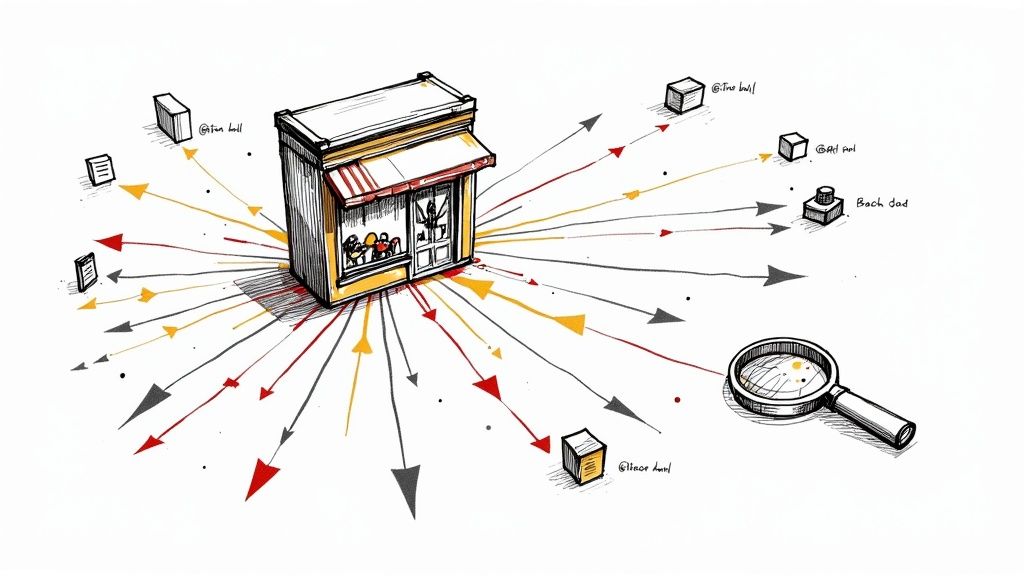
So, what exactly is backlink analysis?
Think of it as taking a deep dive into every single link pointing to your website from somewhere else on the internet. It’s the process of evaluating the quantity and quality of these inbound links. In the real world, it's like reviewing your business's public recommendations—it tells you who is vouching for you, how credible they are, and how much that "word-of-mouth" is helping you grow.
Unpacking the Fundamentals of Backlink Analysis

Let’s use an analogy. Imagine your website is a new bookstore that just opened up. Every time another website links to you, it's like someone on the street pointing customers your way.
Now, if a world-famous author mentions your store, you’re going to see a flood of new customers. That’s a high-authority link. But if a small, local book club gives you a shout-out, it’s still helpful, but the impact won't be nearly as big.
Backlink analysis is the art of studying all those "recommendations." It’s not about just counting them up; it’s about understanding their real value and what they mean for your business. It answers the critical questions that directly shape your SEO success.
Why This Process Is So Important
Getting this right moves you beyond simple link counting and into building a real SEO strategy. To fully grasp this, it's worth understanding the importance of backlinks in organic search engine marketing. A solid analysis empowers you to:
- Gauge Your Online Reputation: See your site through the eyes of search engines like Google, which judge your authority based on who links to you.
- Identify Your Star Players: Pinpoint the high-quality links that are sending you the most traffic and giving you the biggest ranking boosts.
- Spot and Remove Toxic Links: Find low-quality, spammy links that could be dragging your site down and get rid of them.
- Find New Opportunities: By looking at who links to your competitors, you can discover a goldmine of potential websites that might link to you, too.
A handful of powerful, relevant links from trusted sources can be exponentially more valuable than thousands of weak, irrelevant ones. Quality always trumps quantity in the world of backlinks.
To help you get started, here’s a quick breakdown of the core elements you'll be looking at.
Key Components of Your Backlink Profile
| Component | What It Means | Why It Matters |
|---|---|---|
| Referring Domain | A unique website that links to your site at least once. | More unique, high-quality referring domains signal greater authority to search engines. |
| Anchor Text | The clickable text in a hyperlink (e.g., "learn about SEO"). | It provides context to both users and search engines about the linked page's content. |
| Domain Authority (DA) | A score (1-100) predicting a site's ranking potential. Developed by Moz. | Higher DA scores from linking sites pass more "link equity" or authority to your site. |
| Page Authority (PA) | A similar score (1-100) that predicts the ranking potential of a specific page. | A link from a high-PA page is more valuable than a link from a low-PA page, even on the same site. |
| Link Type | Differentiates between "dofollow" (passes authority) and "nofollow" (tells search engines to ignore it). | Dofollow links are crucial for SEO value, while nofollow links can still drive valuable traffic. |
Each of these pieces tells part of the story. When you put them all together, you get a clear picture of your website’s current standing.
The Sheer Scale of Backlink Data
The web of backlinks is massive, and trying to track it all manually is impossible. That’s why we rely on specialized tools.
Platforms like Majestic track billions of data points to give us insights we can actually use. They maintain a Fresh Index (links from the last 120 days) and a Historic Index (data going back to 2006). To put the numbers in perspective, in 2023, Majestic reported that the average domain it analyzed had over 1,800 backlinks from more than 200 different websites. That's a ton of data to sort through.
By tapping into this information, you get a clear, data-backed view of where you stand and a practical roadmap for what to do next.
The Anatomy of a High-Quality Backlink
The first rule of backlink analysis? Not all links are created equal. It's a fundamental truth that shapes every SEO strategy. A single link from a respected industry publication can move the needle more than a hundred links from brand-new, unknown blogs.
So, how do you tell the good from the bad? You start by looking at a few core metrics.
Think of Domain Authority (DA), a score developed by Moz, as a website's overall reputation score. A link from a site with a high DA is like getting a public endorsement from a titan in your industry. It tells search engines you’re the real deal. A link from a low-DA site, on the other hand, is like getting a nod from a stranger—it might not hurt, but it doesn't carry much weight.
Then there’s Page Authority (PA), which zooms in on the strength of a specific page rather than the whole site. Sometimes a single, high-traffic article on a website with a decent (but not stellar) DA can become an authority in its own right. A link from that one page can be pure gold.
It's More Than Just a Numbers Game
Authority scores are just the starting point. A truly deep analysis looks at diversity and context. One of the most important signals is the number of referring domains—that is, the number of unique websites linking back to you.
Getting 10 links from 10 different websites is infinitely more valuable than getting 10 links from the same website. Why? Because each new domain is a fresh vote of confidence from a different source.
A diverse backlink profile, with links coming from many different relevant and authoritative domains, signals to search engines that your website is a widely trusted resource within its niche.
The actual words used in the link—the clickable text known as anchor text—also matter immensely. Good anchor text gives search engines crucial context. A link with the anchor text "expert guide to backlink analysis" tells Google exactly what to expect on the other side, making that link far more powerful than one that just says "click here."
Finally, you have to consider the link's "follow" attribute, which is basically an instruction for search engine crawlers.
- Dofollow Links: These are the gold standard. They pass authority—or "link juice"—from the linking site to yours. Think of it as a direct recommendation that tells search engines, "Hey, this content is great. You should give it some credit."
- Nofollow Links: This attribute tells search engines not to pass authority. While they don't give you a direct SEO boost, they're still valuable. They can drive a ton of referral traffic and help your link profile look natural and authentic.
A healthy profile has a good mix of both. When you put it all together—DA, PA, referring domain diversity, anchor text, and link attributes—you stop just counting links and start understanding their actual impact on your business.
A Practical Guide to Performing Your First Backlink Analysis
Alright, enough with the theory. Let's get our hands dirty. Running your first backlink analysis can feel like a huge task, but it really just boils down to a clear, repeatable process. I'll walk you through a simple framework that turns that mountain of raw data into actionable insights you can actually use.
First things first, you need the right tools for the job. Your budget will probably be the biggest factor here, but the good news is there are great options at every price point. The big players like Semrush and Ahrefs are the industry standard for a reason—their data is incredibly comprehensive, but they do come with a subscription. If you're just starting out, don't overlook free tools. Google Search Console is an absolute must, as it shows you the links Google itself has found pointing to your site.
Exporting and Organizing Your Data
Once you’ve picked a tool, the next step is to run a report on your website's domain. The tool will spit out a massive list—often thousands of rows long—of every backlink it can find. Your job is to export this data, usually as a CSV file, and open it up in something like Google Sheets or Microsoft Excel.
With all that data in a spreadsheet, you can start to make sense of it. The easiest first step is to sort the entire list by Domain Authority (or whatever equivalent metric your tool uses), from highest to lowest. Just doing this one simple thing immediately brings your most powerful and influential links right to the top, helping you focus on what's actually moving the needle.
Evaluating Link Quality to Spot Threats
Now, for a crucial reality check: not every backlink is helping you. A big part of any analysis is sniffing out the potentially harmful or "toxic" links that could be dragging your rankings down. These usually come from spammy, irrelevant sites and can sometimes even be the result of a negative SEO attack from a competitor.
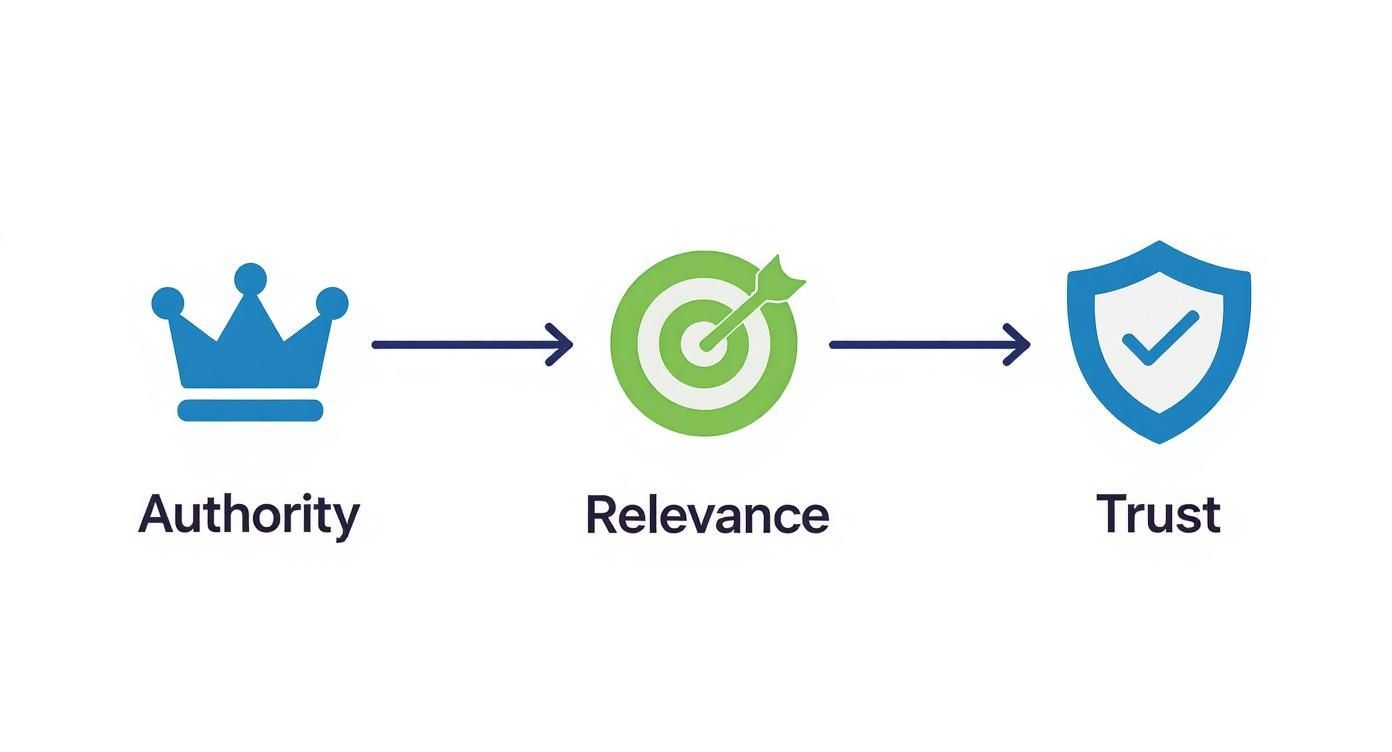
When you're trying to figure out if a link is good or bad, you're essentially checking for three key things, in order.
Think of it as a funnel. A link has to start with Authority, then pass the Relevance test, and finally earn your Trust. A truly high-quality backlink has all three of these in spades.
Keep an eye out for these red flags:
- Links from websites in completely unrelated industries.
- Anchor text that looks spammy or is stuffed with your exact target keywords.
- Links from sites with rock-bottom authority scores and no real traffic.
If you start seeing a pattern of these toxic links, you might need to create and submit a disavow file to Google. This is basically you telling them, "Hey, ignore these specific links when you're looking at my site."
Uncovering Competitor Secrets and Link Gaps
Here's where it gets really interesting. The most actionable part of your analysis is turning the magnifying glass on your competition. Run the exact same backlink reports on your top two or three competitors. Doing this lays their entire link-building strategy bare—you can see exactly which high-authority sites are linking to them.
The real goldmine in a competitor analysis is identifying the "link gap." These are all the websites that are linking to your competitors, but not to you.
This process hands you a ready-made, high-priority list of websites to reach out to. Why? Because these sites have already shown they're willing to link to other players in your industry, which means they are far more likely to be interested in your content, too. For a deeper dive into this tactic, check out our complete guide on how to find backlinks on Google.
By following these steps, you take what seems like a complex SEO task and turn it into a manageable and incredibly strategic process.
Turning Your Backlink Data Into an Actionable SEO Strategy
Collecting backlink data is a bit like mining for gold. The raw material has potential, but its real value is only unlocked when you forge it into something useful. The true power of backlink analysis comes from translating all those charts and numbers into a clear, tangible plan.
This is where you move from "what" to "so what?" You have the data, but what does it actually mean for your business? The first step is to spot the common patterns and red flags in your backlink profile, which will point you toward a strategy that drives real SEO results.
Interpreting Common Scenarios
Let's walk through a few common situations you'll likely uncover during your analysis and what they're telling you. Each scenario hints at a specific set of actions you can take to improve your site's authority and search performance.
- High Link Count, Low Traffic: This is a classic sign of having tons of low-quality or irrelevant backlinks. Your strategy needs a major shift from quantity to quality. Focus on disavowing toxic links and earning new ones from sites that actually have authority.
- Over-Optimized Anchor Text: Does a huge percentage of your links use the exact same keyword-stuffed anchor text? That can look pretty manipulative to search engines. The fix is to diversify your anchor text profile by getting links with branded terms or more natural phrases.
- Sudden Spike in Spammy Links: A rapid, unexpected jump in low-quality links could signal a negative SEO attack. Your immediate priority should be to identify these toxic domains and add them to a disavow file to protect your site’s reputation.
Building Your Strategic Action Plan
Once you've made sense of the data, it's time to build a prioritized action plan. Think of this as a living document that will guide your link-building efforts for the next few months.
Tools with historical data are incredibly helpful here. For instance, using a tool like Semrush, you can track backlink analytics over time and watch for fluctuations that tell you if your strategy is working. A domain’s link count can swing by thousands in just a few months, so scheduling quarterly reviews is a smart way to stay on top of things.
Your action plan will likely focus on three core areas:
- Cleanup and Defense: This is all about finding and either removing or disavowing harmful links that are holding your rankings back. It's the foundational first step for a healthy backlink profile.
- Strategic Outreach: Use what you learned from your competitor analysis to build a target list of high-value websites. A great place to start is with a backlink gap analysis to find easy wins.
- Content-Led Acquisition: Create "linkable assets"—valuable content like original research, ultimate guides, or free tools that naturally attract high-quality backlinks without you even having to ask.
After spotting areas for improvement, some businesses decide to bring in experts and invest in professional authority building packages to accelerate their domain strength.
By turning raw data into these clear, actionable steps, your backlink analysis becomes more than just an audit. It becomes the blueprint for your SEO success.
How to Monitor Your Backlink Profile for Long-Term Success

A great backlink profile isn't something you build and forget. Think of it more like a garden—it needs constant attention to flourish. That’s why backlink analysis shouldn't be a one-time project. It's an ongoing process that protects your site and helps you grow.
If you let your profile go, you're leaving the door wide open for negative SEO attacks, you won't notice when good links disappear, and you’ll miss out on the opportunities your competitors are grabbing. Consistent monitoring turns this from a defensive chore into a powerful way to gather competitive intel.
Establishing a Monitoring Cadence
The key is to set up a simple, repeatable schedule so you don't get buried in data. This helps you spot important changes right away without having to stare at a dashboard for hours every day. A good rhythm blends quick check-ins with deeper, less frequent reviews.
Here’s a practical schedule that works for most businesses:
- Weekly Check-In: Just a few minutes each week is all it takes to check for new and lost backlinks. This is your chance to thank a new site for the link or reach out to reclaim a good one before the opportunity vanishes.
- Quarterly Audit: Every three months, it's time for a more thorough look. This is when you'll hunt for toxic links that need to be disavowed and take a step back to see if your overall strategy needs a tune-up based on what the data is telling you.
The Power of Automated Alerts
Trying to manually keep tabs on your competitors' backlinks is a surefire way to burn yourself out. The smart move is to use automated monitoring tools. They act as your early-warning system, pinging you the moment something important happens.
Imagine getting an email the second a competitor lands a killer backlink. With that alert, you can instantly see their play, figure out who linked to them, and find a way to get a similar link for yourself—all while the trail is still hot.
This proactive approach completely changes the game. Some tools will show you that a competitor gained 1,837 backlinks in a single month. Digging deeper, you might find that 3.6% of those are now broken, revealing a weak spot you can capitalize on. Tracking this kind of information over time gives you a serious strategic edge. You can see how platforms like DataForSEO visualize backlink profile trends to make this data easier to digest. Similarly, our guide on content monitoring shows how automated tracking can uncover these critical competitive insights.
A Few Common Questions About Backlink Analysis
Even with a solid plan, a few questions always pop up when you start digging into backlink analysis. Let's tackle some of the most common ones to clear up any confusion and get you moving with confidence.
Think of this as your quick-reference guide for those moments when you're not quite sure what to do next.
How Often Should I Analyze My Backlinks?
This really boils down to whether you're doing a deep-dive audit or just monitoring your profile.
A full-blown audit is a heavy lift. You're combing through everything, cleaning house, and rethinking your entire strategy. Because it's so intensive, aim to do one every 6 to 12 months.
Ongoing monitoring, however, is a different story. You need to keep a much closer eye on things. A quick check for new and lost backlinks at least weekly, or bi-weekly at a minimum, is the way to go.
This steady rhythm pays off in a few big ways:
- Catch Lost Links Instantly: When a great link vanishes, you'll know right away. This gives you a much better shot at reaching out and getting it reinstated before it’s forgotten.
- Keep Tabs on the Competition: You can see what's working for your rivals in real-time and quickly adjust your own game plan.
- Build Relationships: Noticing a new link gives you the perfect excuse to send a quick thank-you note to the site owner, which can open the door to future opportunities.
For this kind of regular check-in, an automated alert system is your best friend.
What Are the Best Free Backlink Analysis Tools?
You don't need to break the bank to get started. While premium tools like Ahrefs and Semrush are the gold standard, some fantastic free options give you more than enough to work with.
Your absolute first stop should be Google Search Console. It's 100% free and shows you the links Google actually sees and cares about for your site. This is ground truth, straight from the source.
When you're ready to peek at what your competitors are doing, these are great starting points:
- Ahrefs' Free Backlink Checker: This gives you a snapshot of any domain, including its top 100 backlinks and referring domains. It's perfect for a high-level overview.
- Semrush's Free Tier: You get a limited but still very useful glimpse into a competitor's profile, giving you a taste of what their full suite can do.
Between these, you have everything you need to conduct a solid, basic analysis and find your most important links.
Can Bad Backlinks Actually Hurt My SEO?
Yes, they definitely can. Google has gotten much smarter about just ignoring spammy, low-value links. But if your site is attracting a ton of genuinely toxic backlinks, it can still pull down your site's perceived authority.
The real risk comes from a clear pattern of trying to cheat the system. If Google’s webspam team finds evidence of deliberate manipulation—like paid link schemes, private blog networks (PBNs), or other shady tactics—they can hit you with a manual penalty.
A manual penalty is no joke. It can cause your organic traffic to fall off a cliff, and clawing your way back is a long, painful process. This is precisely why you need to regularly check your backlink profile and disavow harmful links. It’s not just about offense; it’s a critical part of defending your website's health.
What Is a Backlink Gap Analysis?
A backlink gap analysis is one of the smartest ways to find your next link-building opportunities. It’s a simple but powerful idea: you compare your backlink profile to two or three of your top competitors. The goal is to find all the websites that link to them but not to you.
This is so effective because it hands you a pre-qualified list of prospects. These sites have already proven they're interested in your niche and link to content just like yours. That means your outreach email has a much, much higher chance of getting a "yes." It’s a shortcut to building a highly relevant and effective outreach campaign.
Stop wasting hours on manual competitor research. ChampSignal sends you high-signal alerts when your competitors land new backlinks, change their pricing, or launch new ads. See what's working for them and react faster. Start your free 30-day trial of ChampSignal today.
Stay Ahead
Don't just find competitors. Stay ahead of them.
Auto-discover new competitors in your market. Get alerts when they change pricing, features, emails, ads, or messaging.
Stay ahead without the tracking busywork.
See competitor pages, emails, social posts, ads, and SEO signals in one place.
What ChampSignal watches for you
The channels competitors own, the places people talk about them, and the alerts that matter when something changes.
Website & Email Monitoring
Page updates, pricing changes, messaging shifts, and competitor newsletters.
Social Monitoring
X posts, Reddit threads, and other public social chatter.
Ads Monitoring
Ad copy, creatives, and landing pages across Google and Meta.
SEO Monitoring
Keywords, backlinks, and ranking shifts tied to competitor pages.
Auto Competitor Discovery
New rivals surfaced before they show up in deals or search.
High-Signal Alerts
The few alerts and digests that matter, delivered by email or Slack.